
The Powerboat Level 2 vs Advanced decision is one of the most common questions we get at Commodore Yachting. People finish their Level 2 course, get a taste for driving powerboats, and then wonder what comes next. The Powerboat Level 2 vs Advanced question is not just about which course is harder. It is about what you actually want to do on the water. One qualifies you to drive a powerboat with basic planning. The other trains you to handle complex passages, higher speeds, and worse conditions. Understanding the Powerboat Level 2 vs Advanced difference before you book saves you time and money, and makes sure you end up on the right course for your skill level and goals.
At Commodore Yachting, based at Premier Gosport Marina on the Solent, Tom and I have taught powerboat students at both levels for years. Some arrive with zero experience and just want a licence to drive a tender or a small RIB. Others have driven boats for years and want the formal qualification to advance their career. The Powerboat Level 2 vs Advanced conversation happens in our office every week. This guide breaks down exactly what each course covers, the skills you need, what they cost, and which one fits your situation.
Understanding the RYA powerboat pathway

The RYA powerboat scheme is separate from the sailing scheme, but it follows a similar stepped structure. You start with an introduction, move through Levels 1 and 2, then progress to the Advanced course, and eventually to the Instructor qualification if you want to teach. The Powerboat Level 2 vs Advanced comparison sits right in the middle of that pathway, which is why so many people get stuck on which one to take next.
The full RYA powerboat pathway looks like this:
- Powerboat Level 1 — Introduction to powerboating. A one-day course covering basic boat handling for absolute beginners. Not a standalone certificate for independent driving.
- Powerboat Level 2 — The standard driving licence equivalent. Covers planning, launching, handling, man overboard, and basic navigation. You can drive a powerboat independently after this course.
- Advanced Powerboat — For experienced drivers. Covers passage planning, night navigation, high-speed handling, advanced man overboard, and emergency procedures. Requires significant logged sea time.
- Advanced Powerboat Instructor — Teaching qualification for those who want to deliver RYA powerboat training professionally.
When people ask us about Powerboat Level 2 vs Advanced, they usually fall into one of three groups. Complete beginners wondering if they can skip Level 2 and go straight to Advanced. Level 2 graduates wondering what the next step looks like. And experienced boaters who have driven for years without formal certification, trying to work out which course to start with. Each group needs a different answer.
What is RYA powerboat level 2?
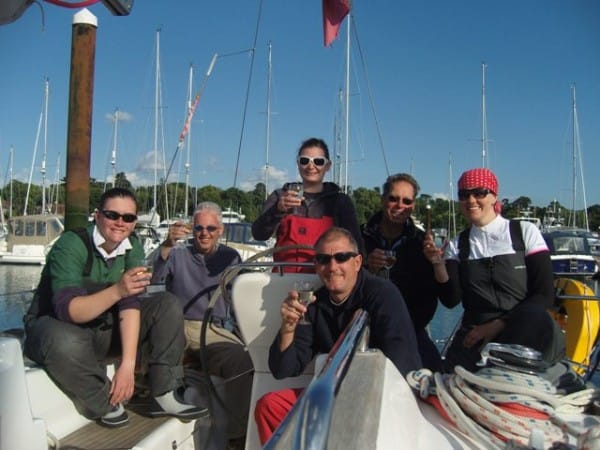
RYA Powerboat Level 2 is the most popular powerboat course in the UK, and for good reason. It is the entry level qualification that actually lets you take a powerboat out independently. Formerly called the National Powerboat Certificate, Level 2 is recognised by insurance companies, marinas, and charter operators as proof of basic competence. The Powerboat Level 2 vs Advanced comparison starts here because Level 2 is where the practical, usable training begins.
The course runs over two days, typically a weekend. You cover both theory and practical elements. By the end you should be able to plan and execute a short passage, handle the boat at planing speed, recover a man overboard, and moor alongside a pontoon in moderate conditions. The syllabus includes:
- Boat preparation and launching from a trailer or trolley
- Low-speed handling and manoeuvring in confined spaces
- Planing and high-speed handling in open water
- Man overboard recovery
- Basic navigation using charts, GPS, and compass
- Collision regulations and buoyage
- Weather forecasts and passage planning
- Towing and anchoring
No prior experience is required for Powerboat Level 2. If you have completed Powerboat Level 1, the first day of Level 2 will feel familiar. But the RYA allows direct entry to Level 2 with no previous course, and most students choose this route. You need to be 12 years old minimum, but there is no upper age limit and no medical requirements beyond being fit enough to handle a boat in a chop.
At Commodore Yachting, we run Powerboat Level 2 courses on our RIBS and training boats from Gosport Marina. The Solent provides ideal conditions — sheltered water for the early stages and open stretches for practising planing and high-speed turns. The Powerboat Level 2 vs Advanced choice for most beginners is straightforward. If you have never driven a powerboat, or you have limited experience, Level 2 is where you start.
What is the RYA advanced powerboat course?

The RYA Advanced Powerboat course is a different proposition entirely. Where Level 2 teaches you to drive a boat safely in good conditions, the Advanced course teaches you to plan and execute complex passages, handle the boat in demanding situations, and make sound decisions under pressure. The Powerboat Level 2 vs Advanced gap is not just a step up in difficulty. It is a fundamental shift from driving to skippering.
The Advanced Powerboat course runs over five days, sometimes split into a three-day plus two-day structure if candidates need a logbook assessment separately. The syllabus covers everything in Level 2 but at a much higher standard, plus a range of advanced topics:
- Advanced passage planning, including tidal gates and harbour approaches
- Night navigation and pilotage
- High-speed planing in restricted waters
- Advanced man overboard in rough weather and at night
- Emergency procedures, including towage and mechanical failure
- Use of radar and advanced electronic navigation
- Search and rescue patterns
- Boat handling in strong winds and restricted visibility
You cannot walk into an Advanced Powerboat course cold. The RYA sets specific pre-requisites. You must hold a Powerboat Level 2 certificate and have logged at least two years of sea time, or 300 miles and 50 hours of logged experience. In practice, most candidates have been driving powerboats regularly for several seasons before they attempt the Advanced course. The Powerboat Level 2 vs Advanced experience gap is substantial, and the RYA designs it that way deliberately.
The assessment for the Advanced course includes a practical exam with an RYA examiner, plus a written passage plan and a viva voce on navigation, safety, and regulations. This is not a course you can breeze through on natural ability alone. Candidates who pass the Advanced course come away with a qualification that is recognised commercially and allows them to progress toward Advanced Powerboat Instructor if they choose.
Key differences: level 2 vs advanced

Let me lay out the Powerboat Level 2 vs Advanced differences in plain terms. These are the factors that matter when you are deciding which course to book.
| Factor | Powerboat Level 2 | Advanced Powerboat |
|---|---|---|
| Duration | 2 days | 5 days |
| Minimum age | 12 | 17 |
| Prior experience | None required | Level 2 + 2 years / 300 miles |
| Navigation level | Basic chartwork, GPS, compass | Tidal passage planning, radar, night nav |
| Speed handling | Introduction to planing | High speed in restricted waters |
| Conditions expected | Moderate, good visibility | Strong winds, night, restricted visibility |
| Assessment | Continuous assessment by instructor | External RYA examiner + viva |
| Commercial recognition | Basic insurance requirement | Industry standard for professional work |
The single biggest difference in the Powerboat Level 2 vs Advanced comparison is the responsibility level. Level 2 certifies you to drive a boat in fair conditions on familiar waters. The Advanced course certifies you to plan and execute complex passages, at speed, at night, in poor weather, with crew depending on you. They are not the same kind of qualification.
Skills and experience required
The Powerboat Level 2 vs Advanced question often comes down to whether you have the necessary skills and sea time to attempt the higher course. Level 2 assumes nothing. You arrive with an interest in powerboating and leave with a certificate. The instructors walk you through every step, from pre-start checks to mooring alongside. You do not need to know anything about tides, buoyage, or collision regulations when you arrive. That is what the course is for.
The Advanced course assumes you already know all of that and can apply it without prompting. The pre-requisite of 300 nautical miles and 50 hours logged is the minimum, but most successful candidates have significantly more. You need to walk onto the Advanced course able to handle a powerboat confidently at planing speed, read a chart, understand tidal streams, and make basic navigational decisions.
The practical difference between Powerboat Level 2 vs Advanced in terms of skill level is roughly the difference between a driving licence and an advanced driving course. Level 2 gives you the basics. The Advanced course refines them under pressure. If you have done a lot of boating but never taken a formal course, the RYA recommends speaking to a training centre about a skills assessment before you book. Some candidates with thousands of miles of experience skip Level 2 entirely and go straight to Advanced after a one-day assessment. This is rare but possible.
Cost and duration comparison

The cost difference between Powerboat Level 2 vs Advanced reflects the course length, the instructor ratio, and the assessment requirements. Level 2 is a two-day course and typically costs between £350 and £500 depending on the training centre, the boat type, and whether the course is run on a RIB or a larger powerboat. Fuel costs are often included in the price, but check before you book — some centres add a fuel surcharge for high-speed courses.
The Advanced Powerboat course runs over five days and costs between £1,200 and £1,800. This includes the practical training, the written exam, and the external examiner fee for the final assessment. Some centres offer split courses where you complete the training block first and return for the exam later. At Commodore Yachting, we include the exam within the five-day format so you finish with the qualification, not a note to come back.
The Powerboat Level 2 vs Advanced cost difference is roughly three to four times, which makes sense given the course duration and the level of instruction. Level 2 courses typically have four to six students per instructor. Advanced courses have a maximum of three students per instructor, and often one-to-one for the assessment phase. The higher instructor ratio accounts for a significant portion of the price difference.
Time commitment matters too. Level 2 fits into a weekend, meaning minimal time off work. The Advanced course requires a full week, or two long weekends if you split the training and exam. For most people the Powerboat Level 2 vs Advanced decision includes a practical question: can you spare a whole week, and is the investment worth it for how you plan to use the boat?
Career opportunities with each qualification
This is where the Powerboat Level 2 vs Advanced choice really matters. Level 2 is not a career qualification on its own, but it is a prerequisite for many marine industry roles. Marinas often require Level 2 before they let you handle their workboats. Yacht charter companies ask for it when you take a RIB ashore. Some watersports centres and sailing schools require Level 2 for basic support roles. It is the minimum standard that the industry trusts.
The Advanced Powerboat certificate is a genuine professional qualification. It is recognised by the Maritime and Coastguard Agency (MCA) as part of the requirements for commercial powerboat operation. Holding the Advanced certificate opens the door to:
- RIB charter and water taxi work
- Powerboat instruction (after completing the Instructor course)
- Safety boat and rescue boat operations
- Marina and harbour launch driving
- Film and media support boat work
- Commercial yacht support and tender driving
The Powerboat Level 2 vs Advanced career path question is simple. If you want to work on the water professionally, you need the Advanced certificate. Level 2 is a useful tick box, but it will not get you a job driving boats commercially. The Advanced course gives you the training, the certificate, and the credibility that employers look for.
Even if you do not want a career in powerboating, the Advanced certificate is worth having for serious leisure boaters. If you own a planing motorboat, do regular crossings of busy shipping lanes, or operate at night, the training you get on the Advanced course will make you safer and more confident. The Powerboat Level 2 vs Advanced choice for leisure boaters depends on how and where you use your boat.
Frequently asked questions
Can i go straight to advanced powerboat without level 2?
Technically yes, if you can demonstrate equivalent experience. The RYA allows training centres to assess candidates for direct entry to the Advanced course if they hold an International Certificate of Competence (ICC) for powerboats or can show logged experience equivalent to the Level 2 standard. In practice, most people with no formal training still need to complete Level 2 first. The Powerboat Level 2 vs Advanced question for experienced boaters usually involves a phone call to the training centre to discuss your logbook and experience.
How long does the advanced powerboat certificate last?
Unlike some commercial certificates, the RYA Advanced Powerboat certificate does not expire. It is a lifetime qualification. However, if you use it for commercial purposes, your employer may require evidence of recent experience or refresher training. The Powerboat Level 2 vs Advanced longevity is the same — both are valid for life, though insurance companies and employers may ask when you last drove a powerboat.
Do i need my own boat for either course?
No. Both courses are run using the training centre’s boats. At Commodore Yachting we use RIBS and rigid powerboats equipped with GPS, VHF radio, and safety equipment. You just need to bring suitable clothing, a notebook, and your lunch. The Powerboat Level 2 vs Advanced equipment requirements are identical — neither course expects you to supply your own vessel.
Which course is better for safety boat work?
Level 2 is the minimum requirement for safety boat roles at many sailing clubs and events. But the Advanced course covers search and rescue patterns, towing under difficult conditions, and night operations, which are directly relevant to safety boat work. If you plan to do safety boat volunteering or paid work, the Advanced certificate makes you significantly more useful. The Powerboat Level 2 vs Advanced decision for safety boaters leans toward Advanced if you have the time and experience.
Can i teach powerboating with the advanced certificate?
Not directly. The Advanced certificate qualifies you to drive a powerboat at an advanced level. To teach, you need the separate RYA Advanced Powerboat Instructor qualification, which builds on the Advanced certificate and includes teaching methodology, lesson planning, and an instructor assessment. Many people do the Advanced course first, gain some experience, and then return for the Instructor course later. The Powerboat Level 2 vs Advanced question for aspiring instructors is really about which stepping stone you stand on first.
Is powerboat level 2 recognised internationally?
Yes, in most cases. The RYA Powerboat Level 2 is widely recognised across Europe and in many other countries. Some countries require an International Certificate of Competence (ICC) for powerboats, which can be obtained alongside or after Level 2. The Advanced Powerboat certificate does not automatically give you an ICC either — you need to apply separately. The Powerboat Level 2 vs Advanced international recognition is similar: both are respected qualifications, but neither replaces the ICC for countries that require one.
What happens if i fail the advanced powerboat exam?
You can retake the exam. The RYA allows reassessment within 12 months of the training course without repeating the full five-day programme. Your training centre will advise on the specific areas that need improvement and arrange a half-day or full-day retest. It is worth noting that the pass rate is high, but the exam is rigorous. Most failures happen because candidates underestimate the passage planning element. The Powerboat Level 2 vs Advanced assessment difference is significant — Level 2 is continuous assessment, Advanced is a formal exam with no room for shortcuts.
If you are still unsure whether the Powerboat Level 2 vs Advanced route makes sense for your situation, the safest answer is to contact an RYA training centre and discuss your experience. At Commodore Yachting we offer free phone consultations to help you decide. You can view our full course list, check our course calendar for upcoming dates, or see how powerboat training fits into a broader sailing education on our RYA Day Skipper skills weekend. For the official RYA syllabus and pre-requisites, visit the RYA powerboat training page.
This guide was written by Tom and Jonno, RYA Yachtmaster Instructors and joint owners of Commodore Yachting.


